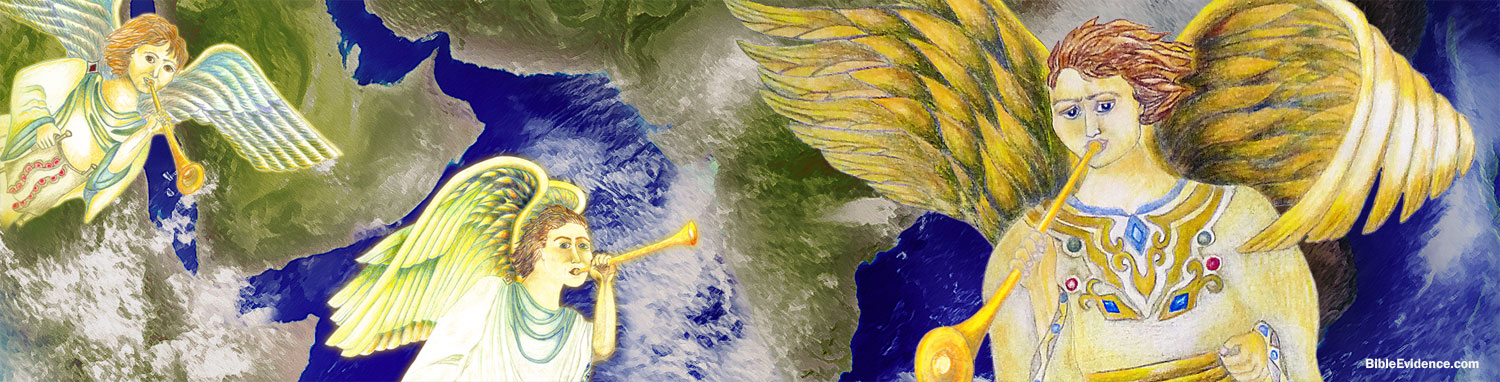
Head #3 - Merovingian Franks
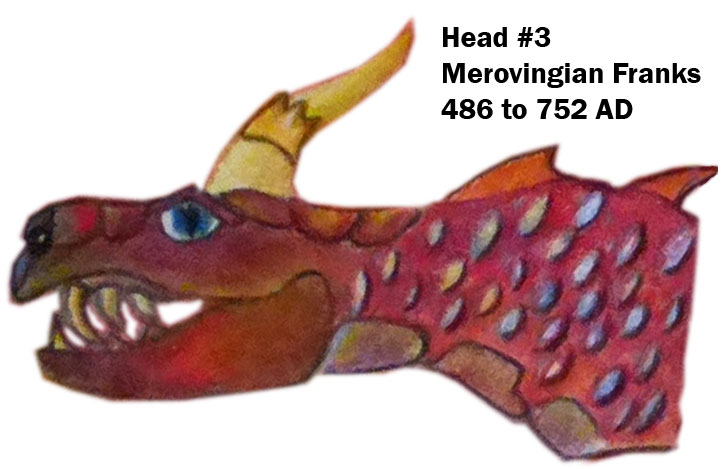
Revelation Time Period #3:
486 AD - 752 AD
Rise
The Franks were moving into the Roman realm by the 3rd century. They were integrated into the Roman armies early on and rose to prominence. Having a thorough understanding of the Roman military, the Merovingian dynasty of the Salian Franks became the dominant power when they defeated the Roman army under the last magister militum (senior military officer) in the western empire in 486 AD (see Head #2 for details on the Merovingian take-over of the realm). This victory enabled them to take over the Kingdom of Syagrius, which was quickly followed by additional conquests. The Frankish kingdom went on to dominate much of central Europe, forcing other Germanic tribes to become tributaries.The rule of the Franks, providing equality between Gallo-Roman natives and those of Germanic origin, along with a common religion, allowed the culture of Roman and Germanic peoples to meld together. Historians refer to the Franks as a continuation of the Western Roman Empire, and as providing the link to the future Holy Roman Empire. The Merovingian kings' authority came by right of heredity, and they "had the absolute authority of a late Roman emperor over all subjects".1
The Franks not only became the dominant political power but allied with the dominant spiritual power. This began taking shape when Clovis, King of the Franks, was converted to Nicene Christianity sometime between 486 and 496. Although most of the population in Gaul were already Nicene Christians, Clovis became the only Catholic prince, helping to distinguish him from other Germanic kings of his time and strengthen the allegiance of his subjects.2
After Clovis defeated the Arian Visigoths in 507-508 AD, the Eastern emperor Anastasius gave Clovis an honorary distinction in 508 AD, and he became the first Christian king (note that this did not imply that Clovis was subject to the eastern emperor). The letter from Anastasius conferred upon Clovis the consular dignity, "from which time he was habitually called consul and Augustus."3 This was the beginning of a partnership between the Franks and the papacy leading to France being called the "eldest daughter of the church."4
As the armies of the Franks spread out across Europe, they were the key force in the spread of Nicene Christianity (which later became known as Roman Catholic). The Arian form of Christianity disappeared, for the most part, by the 7th century.5
See map of the Frankish Empire 481 to 814.
Transition
The papacy began to rise to notable prominence during this time period. When the city of Rome fell in 410, during the papacy of Innocent I, the pope moved in to fill the vacuum of leadership. Its power continued to grow in both spiritual and temporal matters, especially when central rule in the western Roman empire crumbled and the people in Rome looked to it for leadership.The papal power was magnified when the emperor in the east, Justinian, declared the Bishop of Rome the head of all the churches. This occurred in 533 AD as Justinian attempted to eliminate schisms and regain the empire. Recognizing the pope as the highest ecclesiastical authority was important for his plans. The following is an excerpt from the letter from Emperor Justinian to the Archbishop of Rome:
"Therefore, We have exerted Ourselves to unite all the priests of the East and subject them to the See of Your Holiness, and hence the questions which have at present arisen, although they are manifest and free from doubt, and, according to the doctrine of your Apostolic See, are constantly firmly observed and preached by all priests, We have still considered it necessary that they should be brought to the attention of Your Holiness. For we do not suffer anything which has reference to the state of the Church, even though what causes the difficulty may be clear and free from doubt, to be discussed without being brought to the notice of Your Holiness, because you are the head of all the Holy Churches, for We shall exert Ourselves in every way (as has already been stated), to increase the honor and authority of your See.6Justinian made it his mission to regain the western empire and he eventually overpowered the tribes that dissented from the beliefs of the papacy (Heruli, Vandals, Ostrogoths). The prophecy of Daniel 7 predicts the overthrow of these three tribes as a little horn grows stout and plucks up three other horns by the roots (Daniel 7:8,20). The last tribe to be uprooted, the Ostrogoths, occurred in 538 AD, when the siege of Rome, by general Belisarius, ended in victory after a year and nine days. The Ostrogoths, who had the larger army, finally withdrew from Rome on March 12, 538 AD. Though the siege was the first major encounter between the eastern Roman army and the Ostrogoths, it "played a decisive role in the subsequent development of the war."7
This withdrawal of the Ostrogoths from Rome freed the pope to exercise his spiritual power in the realm. This date of 538 marks the beginning of the papacy's ecclesiastical dominance, predicted in various Bible prophecies as continuing for 1260 years. The popes put forth that emperors should defer to the clergy in all matters that concerned the faith (though not all popes in later centuries agreed to defer to the emperors in secular matters).8
The papacy, though theoretically subject to the emperor in the east and involved in various disagreements with the other patriarchs, was given power to exercise authority as the Bible predicted (Rev. 13:2). He began to gain more and more influence in the realm and independent control in Rome.
In practice, the influence of the eastern emperor over western powers was minimal. When Theoderic took the city of Ravenna in 493, his rule was subordinate to the byzantine emperor in outward appearance, but he was in reality an independent monarch.9 With the Germanic tribes forming independent Christian kingdoms during the 6th and 7th centuries, the Byzantine authority became practically nonexistent. Pope Agatho, in 678 AD, was the first Pope not to pay tribute to the emperor, which was customary at the time of election.10 The western and eastern portions of the old Roman Empire had become separate realms.
Though already exercising spiritual dominance (which was definitely accompanied by political influence), the papacy wasn't in a position to exercise political dominance, until the 8th century. It was then that it began to exert influence in determining who would sit in the seat of power in the empire. In the meantime, the church system was being worked into the fabric of Frankish rule.
"At the same time [592-643 AD] we now find clerics playing a much more important role in Merovingian administration, both in royal chanceries and palatia and on the local secular administrative level, anticipating in some ways later Carolingian practices. Thus, in the nuclear regna clerics and especially bishops became increasingly important as an official class, equal in significance to the dukes and patricians who were chosen from the same upper-class land-owning families."11
"The higher clergy there modeled themselves on the military landed aristocracy of feudalism and were rewarded with immense political power. The office of bishop became increasingly a matter of title by birth as aristocratic families sought to have relatives elected or appointed to episcopal office."12The power of the Merovingian dynasty had begun to gradually decline after the Battle of Terty in 687. By the mid-8th century, the Merovingians had become quite weak in actual power, though the loyalty of the people to the ancient Merovingian house was strong and they were still the legitimate rulers of the empire. At the same time, the mayors of the palace (the managers of the king's household) had risen in power and were posed to take advantage of opportunity to take control of the kingdom.
The opportunity came when Pope Zachary gave Pepin III, the Carolingian mayor of the palace, his blessing to depose Childeric and the Merovingian royal house. Pippen desired to more closely unite the papacy and Frankish kingdom. He had been looking for a way to take over the kingship from the Merovingians, but it was unlawful. The Pope, however, was the one power that could give this move legitimacy. The papacy was seen as a moral authority and interpreter of moral law. When the Pope said it was right for Pepin to take over the kingship, the new ruler could then be accepted as the rightful king.
The papal legate then crowned Pepin as ruler. The Catholic Encyclopedia states that, "apart from Spanish examples, the earliest definite instance of unction of a Christian sovereign seems to be that of Pepin, who was first crowned by St. Boniface, the papal legate at Soissons in 752, and again, together with his sons Charles and Carloman and his wife Bertha, by Pope Stephen at St-Denis, Sunday, 28 July, 754."13
"The nature of the authority with which Pepin was invested was emphasized for the first time among the Franks, by the coronation ceremony, which imparted a religious nature to his power and imprinted upon him a sacred character."14 The consecration of Pepin "was a new departure and a significant one. It was a recognition of papal supremacy over the Catholic Church, it bound church and state closer together, and it placed Pepin in the pope's debt."15 Pepin paid his debt by subduing the Lombards in 754 and 756 and giving the conquered land to the pope. This gift is known as the Donation of Pepin and formed the core of the Papal States in Italy, which became the Popes' temporal domain. This gave them independence, prestige and influence among the kings of Europe. "It helped to exalt the Pope's spiritual authority over the heads of kings."16 This new era emphasized a united church and state in order to be a Christian kingdom. The functions of church and state were interwoven into the political and administrative fabric of government. The concept of a Christian kingdom became the driving force of politics. Thus, an emperor or other ruler desired to be crowned by the pope or church representative in order to legitimatize their authority. By 823 AD, the precedent set by earlier rulers and popes was firmly established as "no legitimate emperor was to be crowned without papal participation, and this in due course could come to mean without papal approval."17
By ecclesiastical anointing and ordination, kings were vested with a sacred authority. Even though "men differed about the instruments to be employed, they all agreed that a universal coercive power resided in the church. Whether in the hands of pope, emperor, king, or community, the purpose of human government was to direct men into a single Christian path."18
The papacy, being small and weak, was in theory only powerful while secular rulers cooperated. These rulers, whether because of their own faith or due to the force of public opinion or threat of excommunication, did cooperate, and this made the papal political entity immensely powerful, especially during the 4th period of Revelation.
Decline
When Pepin usurped the palace with the pope's blessing, the last Merovingian king was deprived of his symbolic long hair and banished to a monastery. Thus, the political dominance of the Merovingian dynasty came to an end, and the time period of the Third Head was brought to a close. At the same time, the conditions of the Third Trumpet, the spread of idolatry, came to a close as the new paganized form of Christianity was now cemented into place with the papal success.Summary
Head #3 = The Merovingians were a dynasty of the Franks, a Germanic tribe. Clovis, King of the Franks, defeated the last magister militum (senior military officer) of the western Roman empire in 486 AD, bringing an end to Roman centralized government and becoming the dominant power of a divided Roman realm. He then united all of Gaul under his rule and allied his kingdom with the increasingly powerful papacy in Rome. The Franks brought the afflictions of the 3rd Trumpet judgment upon themselves as their armies ("rivers") spread the corrupt papal ("star" that fell) doctrines, image worship and idolatry ("wormwood") through the Frankish lands of the Roman realm ("third"). The spread of Catholicism was so successful that the papacy (Head #4) was finally able to exert itself in 752 AD to crown Pepin in place of the long-ruling Merovingian Franks, thus becoming the new legitimizing factor for rulers in a realm that wanted to be seen as Christian. This event brought about both the end of the Merovingian power (Head #3) and the successful establishment of idolatry in a third of the realm (Trumpet #3).Continue to: Head #4
Notes:
- 1. Becker, Carl L., and William L. Langer, Editors. A Survey of European Civilization. Second Edition. Cambridge: The Riverside Press, 1952. Page 164.
- 2. Wace, Henry. A Dictionary of Christian Biography and Literature to the End of the Sixth Century A.D., with an Account of the Principal Sects and Heresies. Grand Rapids, MI: Christian Classics Ethereal Library. Page 415. Retrieved from https://www.ccel.org/ccel/wace/biodict.html.
- 3. A Dictionary of Christian Biography and Literature. Page 416.
- 4. "Catholic Church in France," Wikipedia, modified 3 August 2025, http://en.wikipedia.org/wiki/Roman_Catholicism_in_France.
- 5. "Nicene Christianity," Wikipedia, modified 8 August 2025, http://en.wikipedia.org/wiki/Nicene_Christianity.
- 6. Scott, S. P. The Civil Law. Volume XII. The Central Trust Company, retrieved from http://www.constitution.org/sps/sps12.htm.
- 7. "Siege of Rome (537-538)". Wikipedia, modified 16 June 2025, http://en.wikipedia.org/wiki/Siege_of_Rome_(537-538).
- 8. MacCulloch, Diarmaid. Christianity: The First Three Thousand Years. Viking Penguin, 2010. Page 323.
- 9. Christianity: The First Three Thousand Years. Page 320.
- 10. Earle, John Charles. "Manual of the Lives of the Popes". Fathers, Martyrs and Queen of the Holy Rosary, edited by Orsini, Abbe M., Henry Formby, and John Gilmary Shea. New York: Thomas Kelly. Page 54.
- 11. Lewis, Archibald. "The Dukes in the Regnum Francorum, A.D. 550-751". Speculum, 51.3 (1976). Page 394.
- 12. Stagaman, David J. Authority in the Church. The Liturgical Press, 1999. Page 81.
- 13. Thurston, Herbert. "Coronation." The Catholic Encyclopedia. Vol. 4. New York: Robert Appleton Company, 1908.
- 14. Kurth, Godefroid. "The Franks." The Catholic Encyclopedia. Vol. 6. New York: Robert Appleton Company, 1909.
- 15. A Survey of European Civilization. Page 171.
- 16. "Manual of the Lives of the Popes". Page 62.
- 17. Collins, Roger. Early Medieval Europe 300-1000. Third Edition. Palgrave Macmillan, 2010. Page 320.
- 18. Southern, R. W.. Western Society and the Church in the Middle Ages. Penguin Books Ltd., 1970. Page 21.