Linking Guidelines
The points below provide an interpretive foundation and set of guiding principles for the upcoming sections. Many separate prophecies are referenced without going into detailed explanation about each, with the understanding that the reader will pursue further study as needed, allowing the focus of this book to stay on the Trumpets and Heads. The thought process behind linking the 7 Trumpets and 7 Heads of Revelation is here developed step-by-step. (For an introduction to this idea and what it means to sound a trumpet, please see "Judgment & the Sound of the Trumpet" and "Linking the 7 Trumpets to the 7 Heads.)Basic Principles
The thought process behind this study is rooted in three simple principles:- Precedents. One of the main ways the Bible interprets itself is through precedents. For example, in the points below you will see several precedents used to establish guidelines for interpreting the 7 Heads. One of these is the well-known interpretation of the 4 heads on the Leopard in Daniel 7, which meaning is then applied to the 7 Heads on the beast in Revelation.
- Consistency. Another solid way to let the Bible interpret itself is to maintain consistency when interpreting prophetic symbols. If a prophecy is given in symbolic language, like the 7 Trumpets are, then symbols should be interpreted consistently across different prophecies as context permits. For example, the 4th Trumpet describes the sun, moon and stars being darkened. In Rev. 1:20, stars are explained to symbolize the messengers of God's churches. So, the beginning of a simple interpretation of the 4th Trumpet would indicate a time period where God's messages are darkened or obscured as God's true messengers are restricted from preaching.
- Surrender to Jesus. The unfolding of truth only proceeds as the heart surrenders to it. We are drawn to Jesus as we get to know Him. We get to know Him as the Holy Spirit reveals His qualities to us through Bible teachings, nature and providence. Each prophecy, like all topics and stories in the Bible, reveals something about Him and how His kingdom works. Appreciation and acceptance of Him propels the unfolding of prophetic meanings.
The Beast and Its Heads
1. A Beast = A realm
Let's start by looking at the 7-headed beast in Revelation 17. We know from Daniel, and other prophecies in Revelation, that a beast symbolizes a kingdom, or a realm (Dan. 7:23). A consistent application of the symbol of a beast, would mean that this 7-headed beast in Revelation 17 also symbolizes a realm, a single realm. The characteristics of a beast (realm), such as wings, heads and horns, are used to draw attention to a particular phase or aspect of that realm's power (such as papal Rome or divided Rome). Also, Revelation 12 and 13 reveal that Satan is the power behind earthly realms that persecute, and he identifies with his people.This study uses the word "realm" to refer to the great empires or kingdoms symbolized in prophecy (similarly as done in Daniel 11:2 in reference to the "realm of Grecia"). This avoids confusion with terms historians use to distinguish between different phases of a realm, such as the Roman Kingdom (753-509 BC), the Roman Republic (509-27 BC) and the Roman Empire (27BC-476 AD).
2. Heads on a beast = Divisions of political power within a Single realm
Next, let's consider the 7 heads on the beast. Features on a beast, such as wings, horns and heads symbolize characteristics and powers that occur within the realm. The prophecy in Daniel 7 also describes heads on a beast, with its third beast being like a leopard, representing the third of four realms that would rule over God's people from Daniel's day to the Second Coming of Christ (Babylon, Medo-Persia, Greece, Rome) (these realms are also identified in the parallel visions of Daniel 2, 8-9 and 10-12). The leopard-like beast, representing Greece, has four heads, symbolizing a division of power (this division is also described as a horn breaking and being replaced by four horns in Daniel 8:8 and as a kingdom divided four ways in Daniel 11:4). After his death, Greece's ruler, Alexander the Great's (horn that was broken) generals fought for political power and finally settled down into four separate Greek jurisdictions (four horns). The Bible prophetically treats these divisions as part of one beast, or one kingdom, the third realm. A consistent application of the symbol of heads on a beast would mean that the 7-headed beast in Revelation 17 also experiences a division of power. This division would also occur within a single realm (one beast), not across multiple realms.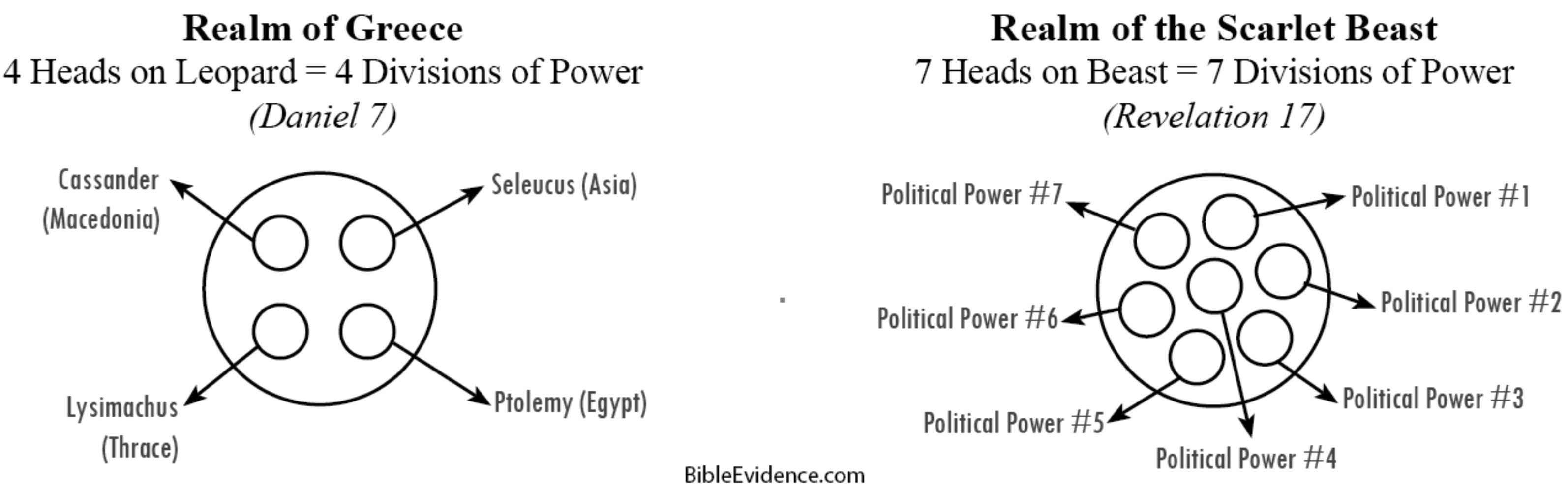
Note: Revelation 12:2 describes the 7-headed beast as having some characteristics like the four beasts in Daniel 7. When a beast has characteristics from multiple realms it does not necessarily mean that the beast represents multiple realms. Because these characteristics are conspicuously listed in reverse order in Revelation, it indicates John is simply looking back in time at the successive realms, whereas Daniel was looking forward in time.
3. The Scarlet Beast = The Realm of Rome
The realm in power from 168 BC until Christ's Second Coming is revealed in multiple prophecies to be the Roman realm during its various phases (e.g. republic, empire, divided, papal, Protestant). That the Roman realm is the last realm before Christ returns, and that it continues until Christ's return, is seen in several prophecies (Dan. 2, Dan. 7, Rev. 12, Rev. 13).The beasts of Revelation 12, 13 and 17 have many ties and look the same, having 7 heads and 10 horns. The beasts in 12 and 17 are also red colored. In addition, they each are described as persecuting God's people during the Middle Ages (Rev. 12:14-15, 13:5-7, 17:6). The beasts in 13 and 17 are also blasphemous. The time periods and descriptions indicate these beasts represent the same Roman realm, with each prophecy emphasizing a different phase of its power (e.g. pagan, papal, Protestant).
Important: The Roman Empire is historically seen as ending in the late 5th century, but it is only Imperial Rome or central rule that ended. A divided Rome continued, and its territory continued to morph over hundreds of years. When Rome divided in 486 AD, its government decentralized into 10 tribes. These tribes then expanded their territory into the New World. Today, the Roman realm (the 4th realm of prophecy) includes the USA, Canada, Australia and other nations established by the tribes. Bible prophecy treats the Roman realm, though divided, as one prophetic unit, one beast, from before Christ's day until the Second Coming.
4. The 7 heads = 7 Successive Divisions of political power within the Roman Realm
Because the 7-headed beast represents the Roman realm, then its heads would represent divisions of powers only within the Roman realm. This is consistent with the four divisions of power within the Greek realm as symbolized by the leopard with four heads and explained as one kingdom being divided four ways in Daniel. The political powers represented by the 7 Heads, would rise to power from within the Roman realm only.The prophecy in Revelation 17 presents the 7 Heads as consecutive powers instead of ruling simultaneously, by the phrase "five are fallen, one is, and one is yet to come". Thus, the heads would represent 7 divisions of power that arise successively within the Roman realm.
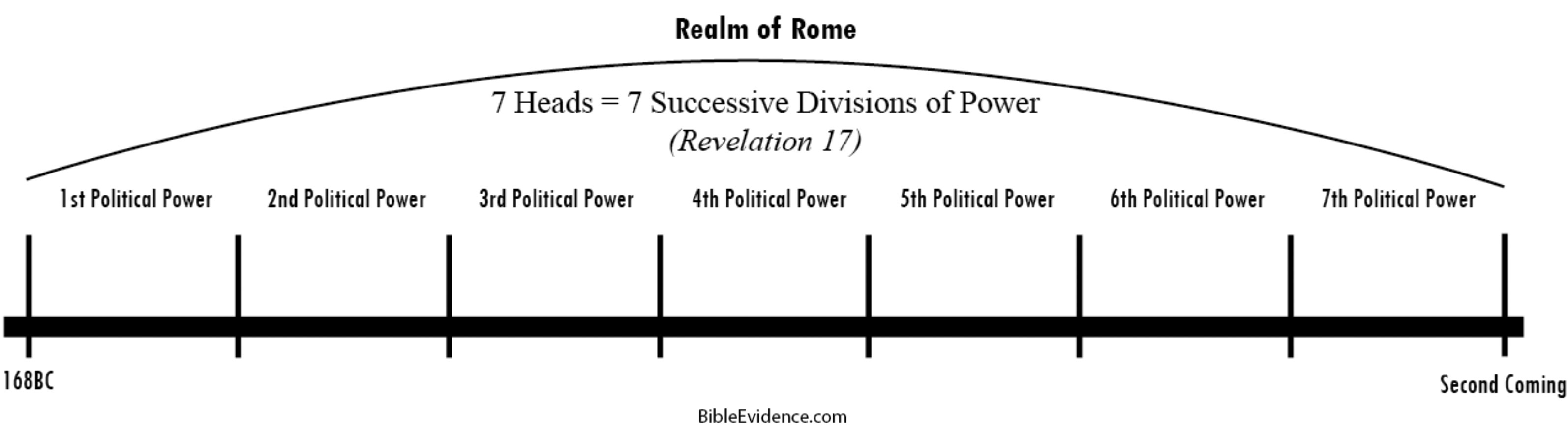
Seven successive time periods are not unusual in Revelation, for the number 7 is used throughout to indicate successive time periods within a whole unit (7 Churches, 7 Seals, 7 Trumpets, 7 Thunders, 7 Last Plagues). This is similar to the week (whole unit), which contains 7 consecutive days (successive time periods) with no gaps. The use of the number 7 indicates completeness, or 7 periods spanned within a whole unit, so the 7 Heads stretch to cover the entire time period of the Roman realm (68 BC to Second Coming).
In contrast to the successive, conquering realms of Babylon, Medo-Persia, Greece and then Rome, the entities represented by the heads are already a part of a realm. They rise to power from within the Roman realm, and operate to influence and control existing governmental structures, whether it be imperial Rome or the 10 tribes of divided Rome (e.g. French, English, German).
The 7 heads on the scarlet beast represent 7 successive political powers covering the entire time period of the Roman realm.
5. One of the Heads = Papacy
In Revelation 13 the beast with seven heads is described as having one of its heads wounded. "And I saw one of his heads as it were wounded to death; and his deadly wound was healed: and all the world wondered after the beast" (Rev. 13:3). The characteristics of the beast reveal it represents the Roman realm when the papacy was ecclesiastically dominant from 538 AD to 1798 AD. The papacy received the deadly wound in 1798 but later revived.Knowing the identity of one of the heads as the papacy gives us clues as to the nature of the heads. They are dominant multinational influences that work across the Roman realm's territory. For example, after Rome divided, there were separate nations that no longer operated under centralized government rule (France, Spain, Italy, etc.). However, they continued to be classified as a single realm in Bible prophecy (one beast), so they are somehow tied together. The heads provide that ongoing centralized influence that ties the nations together.
A dominant political power, such as the papacy, is not necessarily directly in charge of the biggest or most powerful nation(s). But it has extensive influence and exerts dominant political control over those nations. In fact, especially as the Roman Empire divided into separate nations, we would expect successful political powers to be unconstricted by borders and active in multiple nations. The papacy was not necessarily a mighty nation in and of itself, but it had power to convince many other nations to obey it. In addition, since these political powers rise from within the same realm (Rome), we wouldn't necessarily expect to always see violent battles for power, but more of a political positioning or out-maneuvering. Some shifts in power might even be seen as a welcome and necessary response to a catastrophe or changing world and the needs of the citizens.
The 7 Trumpets
1. The 7 Trumpets cover the time period of the Christian Era.
Before the Trumpets sound, an overview scene is provided (Rev. 8:2-6), which focuses on intercession. The filling of the censer with incense and prayers indicate a beginning of a time of intercession as Christ begins His ministry after His resurrection and ascension to heaven. The filling of the censer with fire and throwing it down indicate an ending of intercession as Christ closes His ministry and returns to earth at His second coming. This introductory scene sets the stage (intercession and judgment) and time frame (Christian era) of the 7 Trumpets.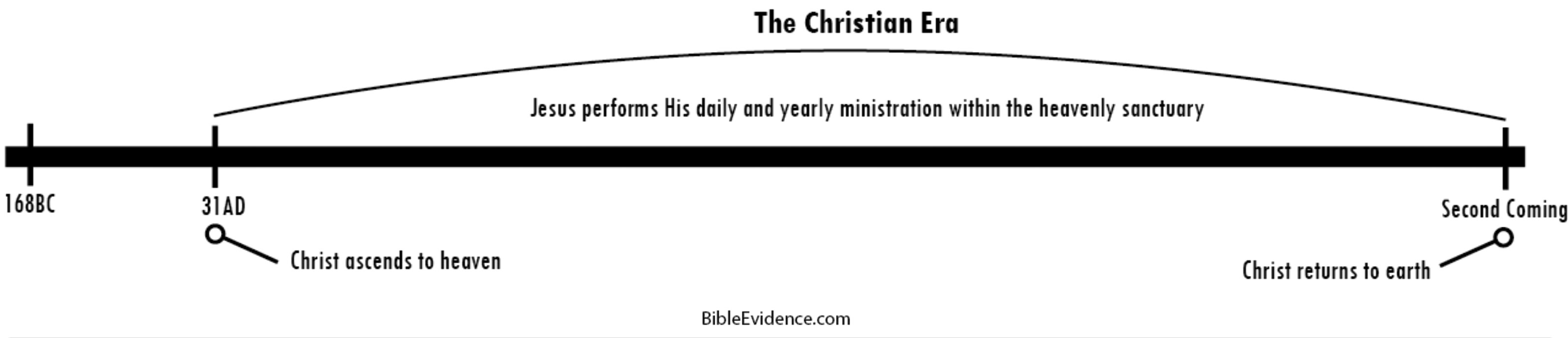
The time frame is also supported by studying the parallelism used by Daniel and John in their prophecies. Each of Daniel's prophecies cover the period of time from his day till the second coming. They each parallel the other, repeating the same basic structure, but adding additional detail relating to the prophecy's theme. Revelation uses the same method, developing parallel prophecies and covering the time from John's day (when Christ's ministry begins in 31 AD) till the Second Coming. Note: Additional evidence for this time frame are presented during Trumpet #7.
The 7 Trumpets are presented sequentially, occurring one right after another. The use of the number 7 consistently indicates 7 successive periods within a whole (like 7 days in one complete week); in this case, 7 successive judgments covering the Christian Era with no gaps inbetween.
2. The 7 Trumpets are judgments on nations resulting from a moral fall.
The language and symbols used within the prophecy of the 7 Trumpets, reveal that it is focused on warnings and judgments. Throughout the Bible, it is shown that nations receive God's judgments after experiencing a moral fall (Jer. 48:21-47, Jer. 49:12-16, Is. 47:6, Jer. 8:7-13, Ez. 5:10-11). Only entities and rulers that practice righteousness avoid God's judgment and stay in power, though it can take a long time to reveal the truly rebellious and wicked state they are in. This is the case because "the throne is established by righteousness" (Proverbs 16:12), "righteousness exalteth a nation" (Proverbs 14:34) and "mercy and truth preserve the king" (Proverbs 20:28).As previously outlined, a nation experiences a moral fall by persistently rejecting God and His laws. This rejection of God causes Him to withdraw His protection and send judgments, which allows disasters to ensue. Through it all, God sends warning messages to call individuals to repent and provide the faithful with instructions to escape the disasters. Eventually, after all have heard the warning, God allows the nation to more fully experience the results of its choices. There can be great hardships and calamities, such as captivity, violent destruction of cities, loss of knowledge, and ultimately, those ruling the nation can lose their power and another ruling entity takes over.
During this time of judgment, the focus is on warning God's true followers so that they can escape to safety and avoid the destruction (plagues/wrath/vengeance) (Ez. 33:4, Luke 21:20-22, Rev. 18:4). The judgments affect ruling powers and the inhabitants of the land, who all have participated in rejecting the warnings (2 Kings 21:10-18). Eventually, after God has done everything that He can to save as many people as will be saved, and the nation has descended into even worse crimes against God, the nation's fall is complete. This results in catastrophes and power being taken out of the hands of the ruling entity and given to someone else. God is in control of these events and thus takes responsibility for placing and removing ruling entities from power (Dan. 2:36-38, Is. 14:24-25, Gen. 15:16, Hag. 2:22).
The 7 Trumpets are judgments (plagues, wrath, calamities) on nations (the inhabitants of the land and its ruling entity) that result from a moral fall (persistant rejection of God and His messages).
Linking the 7 Trumpets & 7 Heads
1. The 7 Trumpets and 7 Heads are parallel prophecies
As mentioned in the previous points, both prophecies cover the same time period and operate as parallel prophecies in revealing additional details about a story. Parallel prophecies are common in the Bible and we should look for the same to occur with the 7 trumpets. Prophecies throughout Daniel and Revelation parallel each other. For example, Daniel symbolizes the realm of Greece in four different parallel prophecies (see chart below), first as the thighs of brass on Nebuchadnezzar's image, then the 4-headed leopard (leopard-like beast), then the goat with the notable horn that breaks into 4 pieces, and finally the realm of Greece divided toward 4 winds (Daniel 11). Each prophecy provides different details, expanding and clarifying on the theme and entities.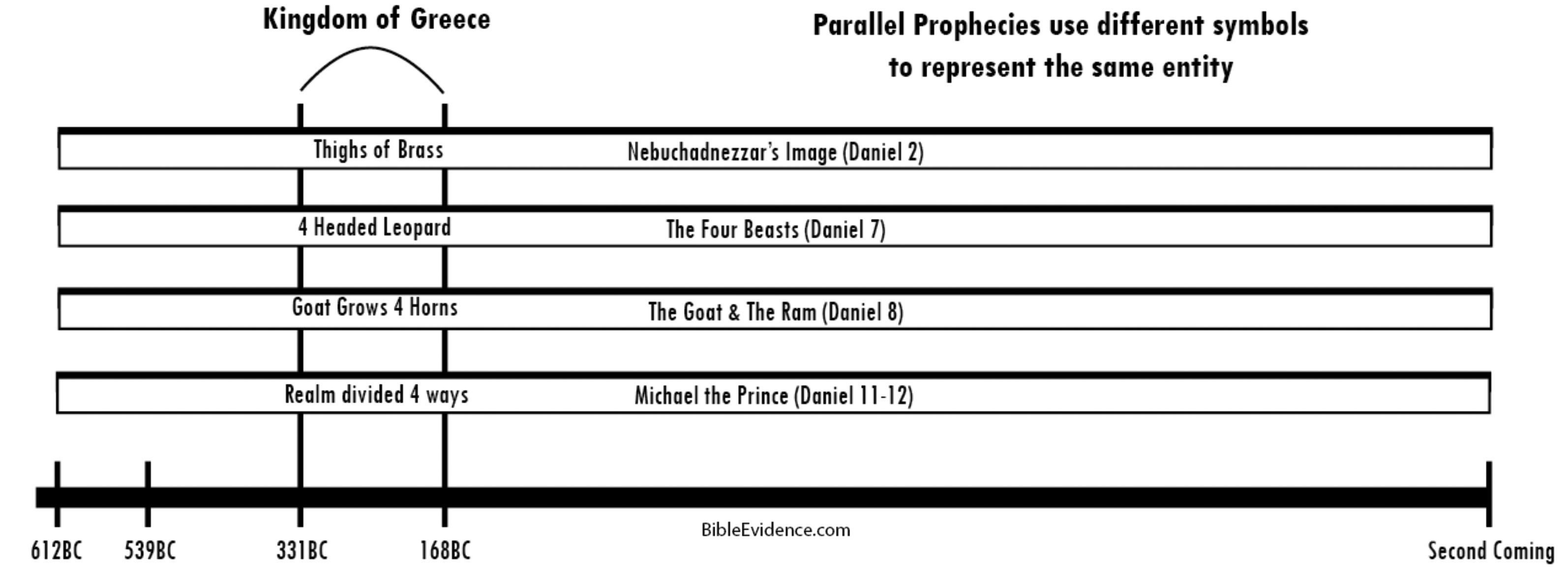 Seeing the same entity represented by different symbols in different prophecies and seeing the same time frame repeated in different prophecies is common. For the 7 Trumpets to be isolated from this parallelism would be unusual. Linking the 7 Trumpets to the same timeframes and entities that occur in other prophecies, such as the 7 Heads, is a Biblical method, which seems well-designed to help us identify meanings and verify interpretations.
The prophecies in Daniel and Revelation use parallelism to unlock meanings and add detail. From a historicist perspective, Revelation builds a story:
- (A) The 7 Churches represent the spiritual condition of God's church over 7 different periods of the Christian Era. The time periods are sequential with no gaps between the time periods.
- (B) Similarly, the 7 Spirits (Rev. 4:5, 3:1) are not 7 different spirits, but rather represent God's wisdom and power through the work of the Holy Spirit within those 7 Churches during those same 7 time periods. Again, there are no gaps between the periods, which makes sense because there is no time when the Holy Spirit isn't at work in Jesus' church.
- (C) In like manner, the 7 Seals represent the conditions (persecution, leadership compromise, spiritual darkness, signs in nature) developing as God's people spread the gospel message over 7 different periods of the Christian era. The manner in which the 7 Seals are given also confirms its time periods are sequential.
- (D) The 7 Trumpets follow the same pattern of revealing characteristics of the 7 different periods of the Christian Era, occurring one right after another with no gaps in between. In addition, the 5th and 6th Trumpets actually provide specific time frames for their sounding, setting a precedent for the other Trumpets to also describe characteristics of large periods of time and not just singular or short-term events.
- (E) The 7 Heads continue to develop the Revelation story through parallels by revealing those who reject the gospel message and have control over God's people during those same 7 time periods.
2. Since the 7 Trumpets outline seven judgments on the ruling powers and inhabitants of the Roman realm, the Trumpets are tied to the prophecy in Rev. 17 that identifies the seven ruling powers.
The political powers brought forth in Bible prophecies are those that are most involved with the experiences of God's people. The seven judgments outlined in the 7 Trumpets are upon those responsible for rejecting the gospel message and persecuting God's people, namely those with political power over God's people. Since the seven judgments are tied to seven ruling powers, we are therefore tied to the 7 Heads that represent the seven ruling powers over God's people during the same time period.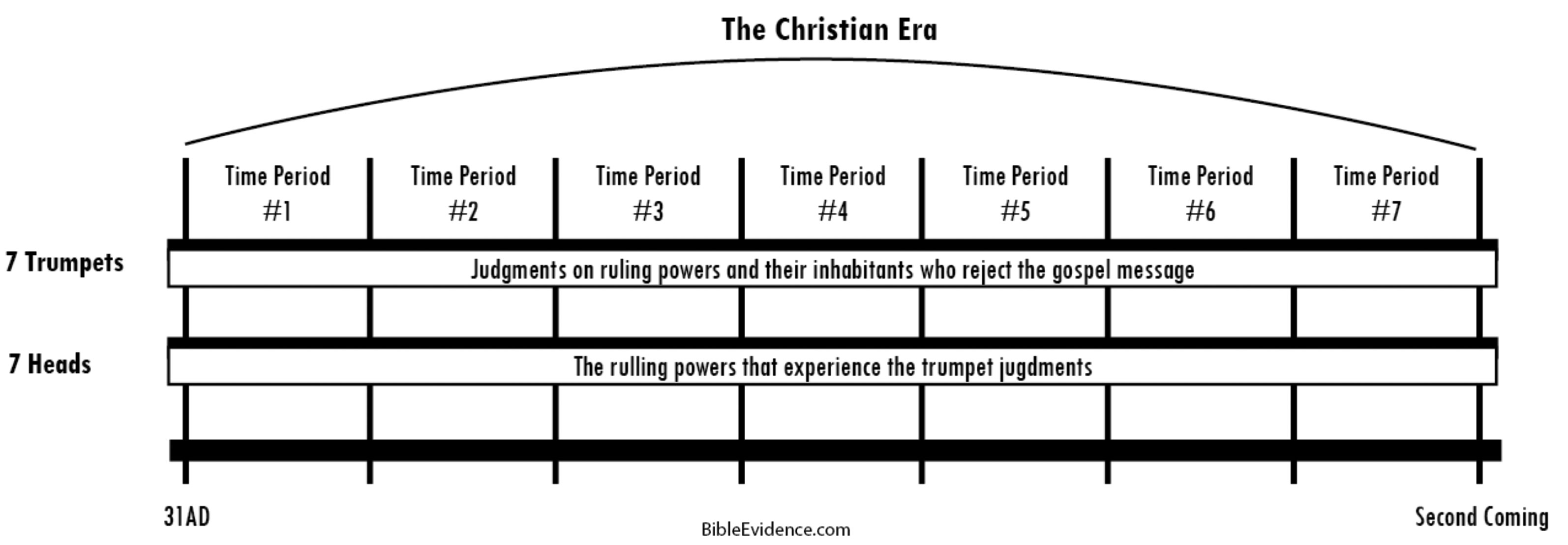
The political powers ruling during the Christian Era are the heads on the scarlet beast, which are the political powers who successively rule within the Roman realm. Thus, the 7 Trumpets and 7 Heads would correspond to the same time periods. For example, the 1st Trumpet would be a judgment upon the 1st head of the beast, the 2nd Trumpet upon the 2nd head, etc.
- Trumpet #1 = Warning and judgment against the first political power and rebelling inhabitants within the Roman realm.
- Trumpet #2 = Warning and judgment against the second political power and rebelling inhabitants within the Roman realm. Etc.
3. Since the 7 Heads experience a fall, which requires judgment, the heads are tied to the prophecy of the 7 Trumpets which outline the 7 judgments.
In Revelation 17, five of the heads on the beast are described as "fallen" (Rev. 17:10). Babylon is also described as fallen (Rev. 14), which later culminates in a complete fall (Rev. 18) and its associated culmination of judgment and destruction (7 last plagues). When the Bible tells of judgment being executed, or an entity losing power, it is the result of a moral fall. The fall of the heads would also be the result of moral falls. Here again, the falls and accompanying judgments of the heads, therefore tie the trumpets (judgments) and the heads (the ruling entities that experience the moral falls and resulting loss of power) together. One is needed to interpret the other.The 7 Heads morally fall, which ties them to the 7 Trumpets that outline their judgment.
Identifying the Heads
1. Is politically dominant During the Trumpet time period.
The time period of an individual head and its corresponding Trumpet represent the time period that the political power has the dominant political influence over the Roman realm (thus it is responsible for the moral fall and God's judgment is just). The time period encompasses the peak of the political entity's power. (Note that the entity may get quite weak by the time God places a new entity in power, but since they are still in power, they are considered the dominant power.) The political power may exist before and after the Trumpet is sounding, because powers take time to rise and decline, but during the trumpet's blast the entity is the dominant influence. This is because God has given the entity power over His people when He took power from the previous entity. Thus it is responsible for the actions it causes against God's people and its leadership in rejecting the gospel message.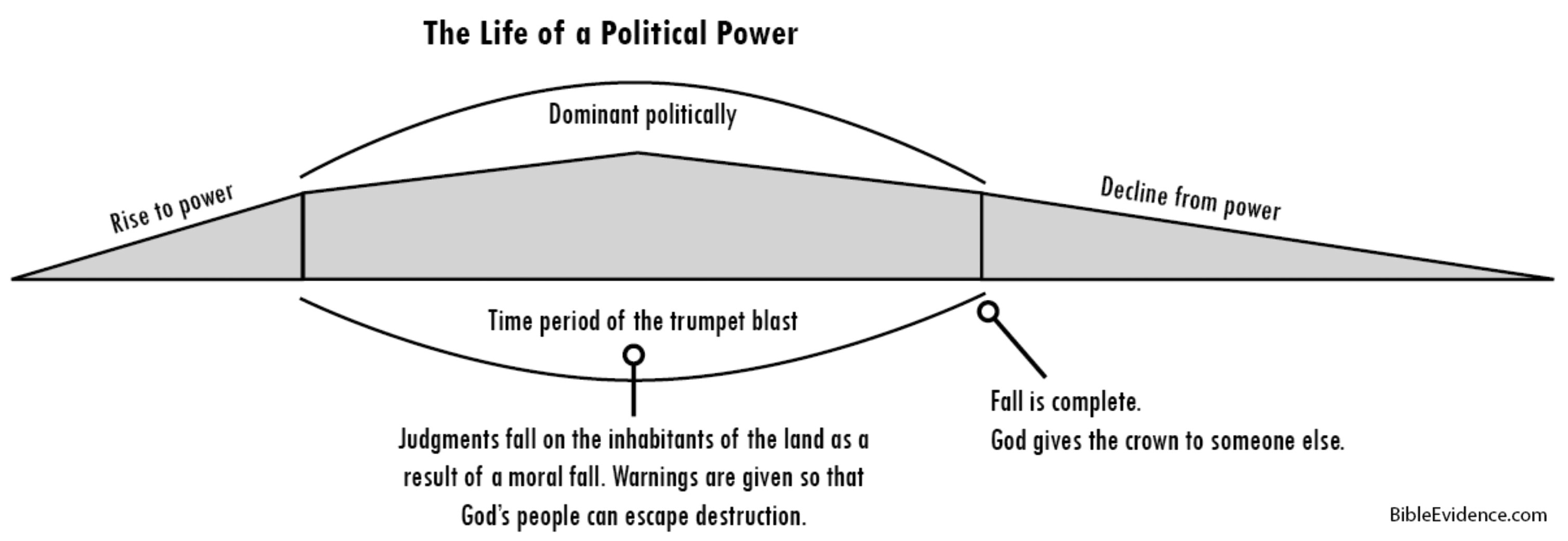
The Trumpet time of judgment comes in the form of spiritual disasters and/or physical destruction as God withdraws His protection and gives them over to other forces, such as an invading army (e.g. Egypt given over to Babylon, Babylon given over to Cyrus' army). The decline in an entity's power begins before they lose dominance, and the entity may or may not still exert some degree of political power after that Trumpet ends. The end of a political power's dominance marks the point when God gives the crown to someone else. The end of the power altogether, may come about quickly, or not occur for hundreds of years after they lose their dominance.
When identifying dominant powers through the history of the Roman realm, it is critical that we correctly understand the territory of the Roman realm. It is important to note that in our day, Roman land is now the territory of the nations of decentralized Rome (10 tribes - Dan. 7), including the expanded territory of those nations (e.g. USA, Canada).
- 1. Anglo-Saxons (English)
- 2. Franks (French)
- 3. Alemanni (Germans)
- 4. Lombards (Italians)
- 5. Suevi (Portuguese)
- 6. Visigoths (Spanish)
- 7. Burgundians (Swiss)
- 8. Heruli (conquered in 493 AD and faded out of history)
- 9. Vandals (conquered in 534 AD and lost distinctive ethnic identity)
- 10. Ostrogoths (withdrew from Rome in 538 AD, and absorbed into the Lombard Kingdom)
2. Overthrows the previous dominant power
A new political entity that rises into power, displaces the previous one, by its force of power or influence (e.g. Medo-Persia is responsible for overthrowing the Babylon realm and becomes the next dominant realm, and then Greece is responsible for overthrowing Medo-Persia and becomes the next dominant realm, etc.). It is common in Bible stories for God to allow one power to displace another power and refer to it as a judgment (Ez. 30:10-19).When God spoke through Ezekiel, He told of how Israel's crown was given to Babylon and the Israelites were taken captive because of their sins. But He also said that Babylon would eventually be overturned, and so on, until the crown would finally be given to Christ and sin would end.
"The word of the LORD came unto me again, saying, Also, thou son of man, appoint thee two ways, that the sword of the king of Babylon may come: both twain shall come forth out of one land: and choose thou a place, choose it at the head of the way to the city... Therefore thus saith the Lord GOD; Because ye have made your iniquity to be remembered, in that your transgressions are discovered, so that in all your doings your sins do appear; because, I say, that ye are come to remembrance, ye shall be taken with the hand. And thou, profane wicked prince of Israel, whose day is come, when iniquity shall have an end, Thus saith the Lord GOD; Remove the diadem, and take off the crown: this shall not be the same: exalt him that is low, and abase him that is high. I will overturn [Medo-Persia overthrows Babylon], overturn [Greece overthrows Medo-Persia], overturn [Rome overthrows Greece], it: and it [Judah's kingship] shall be no more, until he come whose right it is; and I will give it him [Christ's eternal realm]." (Ezekiel 21:18-19, 24-27 KJV).There is an unbroken succession of power as the crown is passed from one entity to the next. This is the same with the political entities (7 Heads) within the Roman realm (beast) ("7" indicates 7 successive units within a complete whole). There is an unbroken succession of power, as only one entity can be politically dominant at a time. Thus, if a particular political power is identified, the power before and after it can be identified by determining who it overthrows and who overthrows it. This guideline will be very clearly illustrated as we study the history of these political entities.
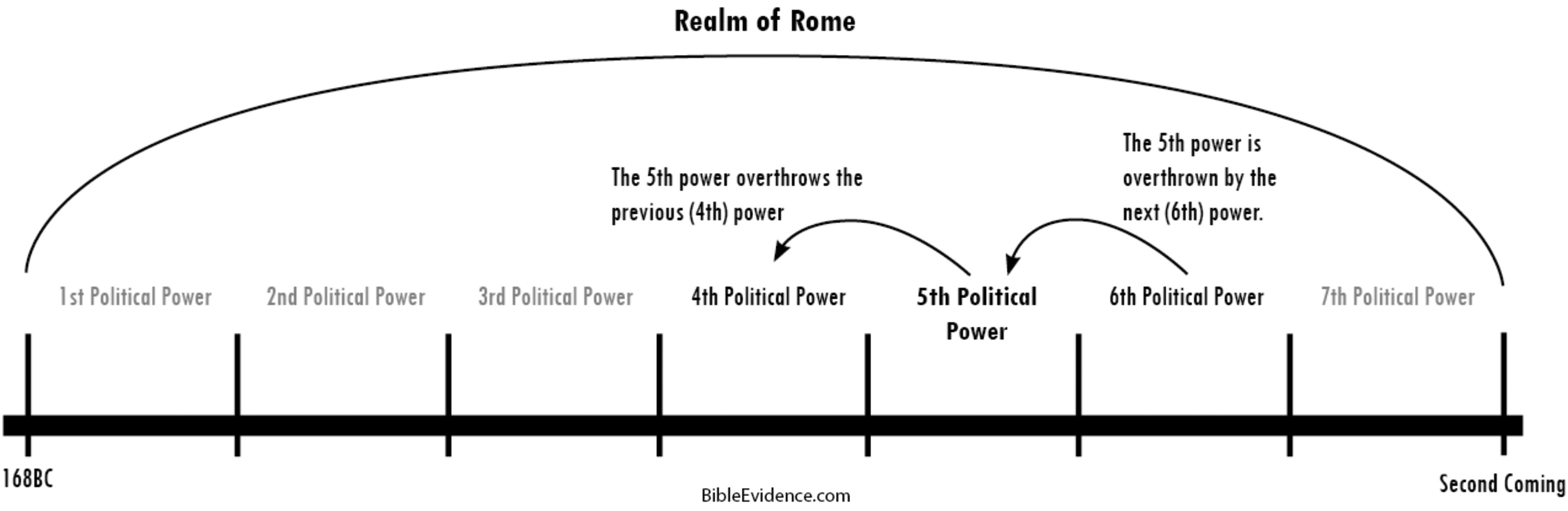
A dominant power is responsible for overthrowing the previous dominant power. A dominant power is overthrown by the next dominant power.
3. Controls the Seats of power
For a political entity to be considered dominant, it needs to establish control of the crown in the most powerful nation(s) of the Roman realm. This means it would have the power to determine or ruin emperors and government leaders. It would also have a strong cultural and economic influence over the region. The date power shifts from one entity to the next, and therefore the start of a new Trumpet time period, can be identified by determining when the political entity gained the power to establish who sits on the seat(s) of power. This can mean that someone within the entity itself sits on the throne, or that it chooses or legitimizes who does sit on the throne. Note that a political entity can be seen as quite weak by the end of its reign, but it is still in the power position until the next entity takes over. Identifying the seat(s) of power in the realm is accomplished by determining the location of the mightiest nations within the realm.Being the dominant political power or "emperor chooser", doesn't mean that the political entity is in control of all events. On the contrary, many of these political entities are often suppressed and undermined by the emperors themselves. It appears the struggle for power and in-fighting are constantly manifested throughout the history of the Roman realm. The power that legitimizes the ruler and the ruler himself often have a troubled relationship of constantly attempting to subjugate the other.
Being a dominant political power means sitting on, determining who sits on, or legitimizing who sits on the seat(s) of power.
4. Time of dominance corresponds to the Trumpet time period
The Trumpets include descriptions of judgments that affect the inhabitants of the land of the ruling political entity. Remember that God's judgments are not haphazardly given, but fair and affect an identifiable entity or group of people. The time period that one political entity is dominant is characterized by one Trumpet judgment. This includes any time prophecies given in the Trumpet. For example, in the 6th Trumpet, a period of time for the judgment to occur is defined. The time period would then also designate the length of time the ruling entity is dominant.The time period of a political power's dominance is characterized by the events described in the corresponding trumpet.
5. Causes Trumpet calamities
The actions of a ruling power in rejecting God's laws bring about the conditions described in the Trumpet. Since nations bring judgments upon themselves, the conditions of the Trumpet can be linked to the actions (or inaction) of the ruling power. This relationship between nations rejecting God and the resulting judgment is not vague or distant, but an intimate connection of Biblically guaranteed cause and effect. Thus, the descriptions of a Trumpet provide insight into the political environment of the time period and the events with which ruling entities are primarily dealing.Cause and effect. Since nations bring judgments upon themselves, there will be evidence that the calamities described in the Trumpets will be caused or allowed to occur by the nations themselves.
Summary of Guidelines
The guidelines for linking the 7 Trumpets to the 7 Heads of Revelation are summarized as follows:- The beast of Revelation symbolizes the Roman realm, and its 7 heads symbolize 7 successive divisions of political power within the Roman realm (a beast = a single realm). One of the heads is the papacy.
- The 7 Trumpets are judgments (afflictions, plagues, calamities) on nations (inhabitants of the Roman realm and its ruling political powers) that reject the gospel message and have control over God's people during 7 successive time periods (with no gaps between) stretching from Christ's day until the Second Coming.
- Judgments occur as a result of a moral fall by a nation and its ruling political powers. The Heads reveal the identity of those political powers. The Heads on the beast are said to have "fallen" (Rev. 17:10), which includes a moral fall and accompanying judgment. The Trumpets reveal those judgments. Thus, the 1st Trumpet coincides with the reign (politically dominant phase) of the 1st head on the beast, the 2nd Trumpet coincides with the reign of the 2nd head on the beast, etc. This places these two prophecies on parallel timelines, a common occurrence in the Bible as later prophecies parallel and expand upon the first.
- During the time period of a Trumpet, the corresponding political power (Head) has a multinational and dominant influence in the realm. This means sitting on, determining who sits on, or legitimizing who sits on the seat(s) of power. A dominant power is responsible for overthrowing the previous dominant power and a dominant power is overthrown by the next dominant power. We can then expect a shift in dominant power as each Trumpet transitions, and future chapters will demonstrate this exact correlation in history.
- The time period of a political power's dominance is characterized by the events described in the corresponding Trumpet. Since nations bring judgments upon themselves, the conditions of the Trumpet can be linked to the actions (or inaction) of the ruling power. This relationship between nations rejecting God and the resulting judgment is not vague or distant, but an intimate connection of Biblically guaranteed cause and effect.
- The territory of the Roman Realm includes the expanded territory of the 10 tribes (Dan. 7). Thus, the USA is part of the Roman Realm.
- When unlocking prophetic symbols, they should be interpreted consistently and in line with precedents, to let the Bible interpret itself. As we are drawn to and surrender to Christ, prophecy becomes ever clearer. We can see prophecy unfold as His love and long-suffering are revealed during each stage of history and He is proven right and just in all His judgments.
What to Expect
In this study, each Trumpet and corresponding Head are examined to see how they fit into the guidelines established in the thought process outlined above.- 1. First, the symbolism of a Trumpet is examined, which reveals the conditions, characteristics and political environment of the time period.
- 2. Second, the dominant political power (Head) during the time period is identified in history, ensuring it meets all of the requirements, including bringing the affliction on itself by its own actions, controlling who sits in the seats of power, and being responsible for the overthrow of the previous power.
- 3. Finally, the transition of power to the next entity (Head) is described and pinpointed in time.
Return to Linking the 7 Trumpets to the 7 Heads