Head #7: Freemasonry (Part II) - The Beast that Ascends from the Bottomless Pit
Return to Head #7: Freemasonry (Part I)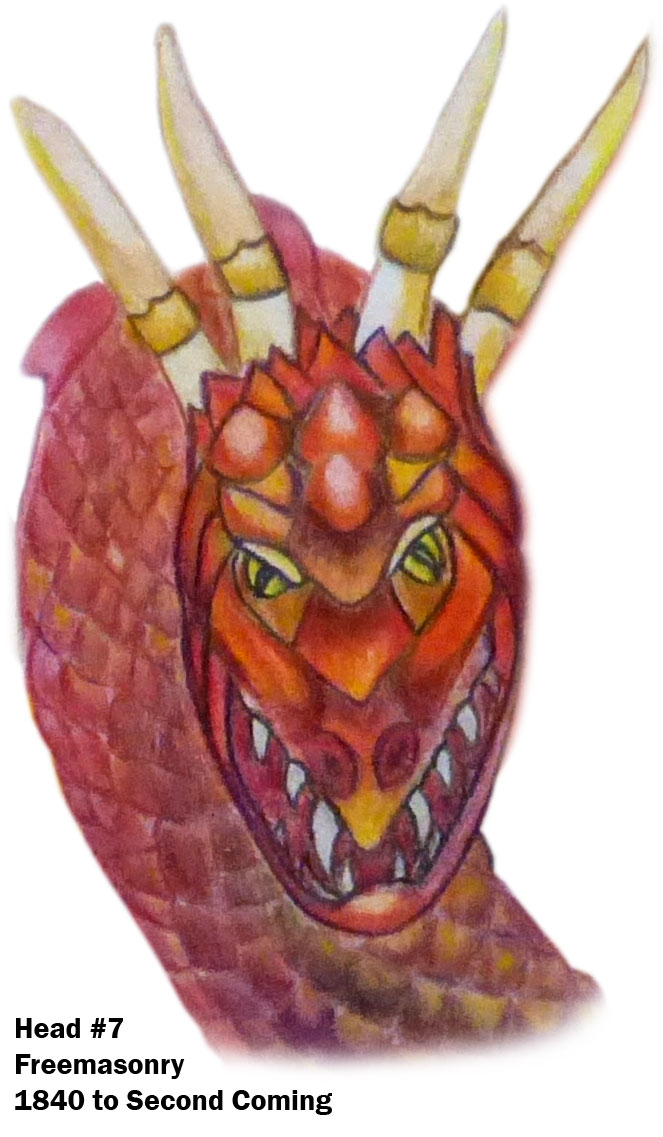
Revelation Time Period #7:
1840 AD - Christ's Second Coming
In Revelation 12, 13 and 17, the scarlet beast with 7 heads and 10 horns represents the Roman realm in its various phases. This same beast is also described in Revelation 11. Notice the following comparison:
- a) The beast in Revelation 17 would ascend from the bottomless pit and was seen at the end of the papal power's 1260-year ecclesiastical reign (538-1798 AD) (Rev. 17:1-6). The beast is directed by a woman (church) that is a spiritual kingdom called the "great city" (Rev. 17:5,18).
- b) The beast in Revelation 11 would ascend from the bottomless pit and was seen when the two witnesses (God's word) were ending their 1260 years of being suppressed (538-1798 AD). The beast wars against God's people and His Word from within a spiritual "great city" (Rev. 11:8).
- This beast that ascends out of the bottomless pit symbolizes the same entity in both Revelation 11 and 17. This provides another key to understanding the identity of the 7th Head, because it is the same power that is identified in the prophecy of Revelation 11.
- Let's examine this interesting prophecy in Revelation 11. It is provided in the Bible after the description of the 6th Trumpet and before the 7th. This prophecy, along with the other interlude prophecies, reveals events leading up to and during the transition into the 7th Trumpet. It specifically predicts the major events and characteristics of the French Revolution.
The Prophetic Symbols
"And I will give power unto my two witnesses, and they shall prophesy a thousand two hundred and threescore days, clothed in sackcloth... And when they shall have finished their testimony, the beast that ascendeth out of the bottomless pit shall make war against them, and shall overcome them, and kill them" (Revelation 11:3,7).The beast in Revelation 11 is a realm (kingdom), just like beasts in all other prophecies. The beast cannot just symbolize an idea, doctrine, or theory of social organization, but must represent a realm/kingdom/political entity with an identifiable ruling power, such as Babylon, Medo-Persia, Greece or Rome (a beast symbolizes a realm/kingdom - Daniel 7:23). Horns and heads on a beast can further identify phases, political powers or divisions within a single realm (such as the papacy, Habsburgs, Franks, Ostrogoths, etc., within the Roman realm).
This beast that ascends from the bottomless pit in Revelation 11 has several characteristics:
- It rises at the end of the 1260 years (538-1798 AD) of papal ecclesiastical supremacy (they shall prophesy a thousand two hundred and threescore days).
- It would seek to eliminate the Word of God (killed the two witnesses) for 3-1/2 years (3-1/2 prophetic days) around 1798 (the end of the 1260 years of witnessing in sackcloth or being suppressed).
- It would exhibit the characteristics of Sodom (licentiousness).
- It would respond to God like Egypt (daring rebellion).
- It would behave like those who crucified Jesus (persecute and kill).
France had long been united with the papacy in suppressing the Word of God and persecuting those of non-Catholic beliefs, being responsible for conducting some of the cruelest slaughters in the Roman realm. They were instrumental in enforcing the papacy's demands for the 1260-year time period. But, during the revolution, there was rebellion and over-reaction to their former religious zealotry. They threw religious constraints completely off.
"When fifty thousand French priests and one hundred and thirty-two French bishops refused to accept the Constitution of 1791, which Louis XVI. had felt constrained to approve, the pope issued a Bull denouncing the Constitution and prohibiting its acceptance by the French clergy. The French National Assembly retaliated by confiscating Avignon and Venaissin, papal possessions in France, and the pope was helpless. Excommunication and interdict had lost their force, for the people no longer believed that their temporal or spiritual well-being was in the hands of pope or priest, and they could smile at papal and prelatical anathemas. The confiscation of the estates of the church, the complete abrogation of ecclesiastical privileges, the proscription and persecution of the clergy because of their opposition to the revolution, and finally the legislative annihilation of the Christian religion with the attempt to obliterate all Christian institutions by changing the calendar, etc., grew out of the widespread popular conviction that the dominant form of Christianity, with which Christianity itself was identified, was the arch-enemy of human rights and the enslaver of men's bodies, minds, and consciences."1France's war on God's word culminated in 1793, for the time period defined in the prophecy as 3-1/2 years (3-1/2 prophetic days), when religion was officially outlawed in France. A heaven-daring, rebellious and atheistical attitude was displayed as efforts to de-Christianize the nation commenced. The worship of the Deity was abolished by the National Assembly. It was declared that they had no god but Reason and devoted themselves to the homage of liberty, equality, virtue, and morality.
A definite licentiousness was displayed as the population unleashed its restraints. The ruling government that took over in 1794, called the Directory, was particularly known for its corruption and politicians who enjoyed living luxuriously and beautiful mistresses.2
Persecution, which had often been centered in France during the previous centuries, came forth in unprecedented fury during the revolution. It is estimated that up to 250,000 lives were taken during the revolt in 1793.
"The beast that ascendeth out of the bottomless pit shall make war against them, and shall overcome them, and kill them." The atheistical power that ruled in France during the Revolution and the Reign of Terror, did wage such a war against God and His holy word as the world had never witnessed. The worship of the Deity was abolished by the National Assembly. Bibles were collected and publicly burned with every possible manifestation of scorn. The law of God was trampled underfoot. The institutions of the Bible were abolished. The weekly rest day was set aside, and in its stead every tenth day was devoted to reveling and blasphemy. Baptism and the Communion were prohibited. And announcements posted conspicuously over the burial places declared death to be an eternal sleep."3
The power that ruled France during the Revolution
In the quote above, Ellen G. White provides insight by equating the "beast from the bottomless pit" to the "atheistical power that ruled in France during the Revolution and the Reign of Terror". Identifying the beast as France is accurate, but to understand the symbols more fully and to understand how the beast reappears in Revelation 17, we have to identify the specific entity ruling in France during the Revolution.We've previously examined historical details and sources revealing that the ideas of Freemasonry were at the heart of the French Revolution. It is clear that key leaders in the revolution were Freemasons, including many of the army, La Fayette (commander of the National Guard) and approximately 40% of his officers, election committee members, 247 of the 749 members elected during the third parliament, and at least 320 of the 1,336 delegates to the Estates-General, and others. Also, the resulting leadership under Napoleon was predominantly made up of Freemasons.
Freemasons were involved throughout the political spectrum, from radicals to royalists. What started out as a noble fight for freedom, however, descended into chaotic, bloody anarchy. Freemason author Christopher Hodapp writes that "at first, the public admired the Freemasons and their motto of 'Libertie! Egalitie! Fraternitie!' (Liberty, Equality, Brotherhood!) But the Revolution quickly degenerated into years of murder and terror, and many people began to identify the Masons with those years of madness."4 Though initiated by Freemasons, the Revolution turned out in ways they hadn't planned. The moralless and cruel events that followed were shocking. In fact, many Freemasons perished during those years, some as they fought for higher ideals and some as they defied God and persecuted others.
The chaotic Revolution in France reflects the confused state of French Freemasonry at the time. Before and after that time, dozens of Masonic groups and orders formed, developing almost 1,400 different degree rituals.5 There were various ideas on how best to go about achieving revolution and reform, which was apparent in the chaos of the revolutionary years.
Jacobins, Illuminati and Freemasonry
The popularity of Freemasonry gave rise to various organizations that copied its structure and policies. These secret clubs and societies recruited from the ranks of Freemasonry membership and patterned their formation after Freemasonry with the various system of degrees, secrecy, instruction and organization. Some of these many organizations were legitimately linked to Freemasonry and some were not. In a 1984 speech by Jeremy Pemberton, President of the Board of General Purposes of the United Grand Lodge of England, he overviewed the history of Freemasonry and explained that "Europe was to be a fertile ground for the development not only of the Craft but of many additional degrees. It was, unfortunately, also to be a fertile ground for the perversion of genuine Freemasonry for political ends, and many pseudo-Masonic organisations grew up which were in fact political clubs." He goes on to say that "it was for this reason, as well as on account of the taking of oaths and our Masonic secrets, that the Vatican issued the first papal bull against Freemasonry in 1738, a Bull which was to be reinforced on a number of occasions in the following hundred and fifty years." He asserts that "these continental pseudo-Masonic political and anti-clerical societies also inspired the great conspiracy theory of Freemasonry; the theory of its being an international organisation working for world domination in a political sense; and this led to the many attacks on the integrity of Freemasonry in the 19th and 20th centuries, many of them deliberately fabricated by their authors to achieve political ends."6Historian Una Birch writes about the large number of lodges and rites and non-Masonic secret societies leading up to the French Revolution. She states that the Masonic "social system was riddled with mystical societies which gathered their initiates from among the adepts of Masonic grades, and owned allegiance to no supreme council."7
The Jacobins and the controversial Illuminati are both organizations that gained momentum during this same time. There has been much effort by conspiracy theorists to link the Jacobins and Illuminati to Freemasonry. Even if the clubs were not officially linked, their formation was patterned after Freemasonry, with the various system of degrees, secrecy, instruction and organization, which certainly reveals the strong influence and prominent position of Freemasonry. In any case, according to Freemasons themselves, there do appear to be certain links. We will briefly look at some evidence in this regard, beginning with the Jacobins.
Jacobins
The Jacobin Club, named after the location where they met in the Rue St. Jacques (Latin: Jacobus), grew quickly, gaining an estimated membership of 420,000 throughout France. A good number of French Freemasons became Jacobins.8
"Contacts and co-operation between French freemasonry and the Club of Jacobins are mostly accepted by historians. The club when transformed according with the revolutionary strategy defined by Robespierre or Mirabeau, acted according to freemasonry rites, rules of secrecy and organization [which] helps to understand its expansion to all French territory."9It was the Jacobins, who are credited with bringing about the worst aspects of the revolution. After gaining momentum and being able to sway the opinions of leaders early on, they took the next step of directly taking power in 1792.10 There were many other opposing groups, such as the Cordeliers, the Society of 1789, the Feuillants, and the powerful Girondins. The Girondins, made up largely of Freemasons, disagreed with the methods used by the Jacobins, but were eventually killed as so many others. As an example, followers of Robespierre (leader of the Jacobins) guillotined the Duke of Orleans, who was the Grand Master of the Freemason lodge the Grand Orient of France.11
The reign of the Jacobins is termed the "Reign of Terror" in France, during which persecutions and abuses of power flourished. Freemasonry denounces the excesses of the French Revolution under the Jacobins and understandably would try to distance itself from such actions. Yet, though there are differences in opinion regarding the extent of the connection, the evidence indicates that there was, at least for a time, a degree of cooperation.
Historian Una Birch researched the planning of the revolution and coordination among secret societies and describes how at the beginning of the Revolution most of the Masonic and illuminist lodges shrank esoterically but expanded exoterically as clubs and popular societies. She states that "the old theoretical discussions within the lodges as to how the Revolution should be conducted, produced in action the widest divergences, and Jacobins, Girondins, Hebertists, Dantonists, Robespierrists, in consequence destroyed each other."12
Illuminati
The Illuminati was founded on May 1, 1776 by Adam Weishaupt. It was modeled after Freemasonry lodges.13 It had a slow start until a prominent diplomat joined them in 1780 by the name of Baron Adolf Franz Friederich Knigge. According to historian Vernon L. Stauffer, Knigge effected an alliance between the Illuminati and Freemasonry, and the Order grew rapidly. Furthermore, recruits were gained from the lodges of Freemasonry.14 Weishaupt also "caused all his own disciples to become masons."15 By 1784 there were between two and three thousand members, spread across multiple countries. Una Birch describes the integration of these two societies:
"At the great Convention of Masonry held at Wilhelmsbad in 1782, the Order of the Strict Observance was suspended, and Von Knigge disclosed the scheme of Weishaupt to the assembled representatives of the Masonic and mystical fraternities. Then and there, disciples of Saint-Martin and of Willermooz, as well as statesmen, scientists, magicians, and magistrates from all countries, were converted to Illuminism. Illuminati doctrines percolated everywhere through the lodges of Europe... So well did the Illuminati missionaries work that by 1788 every lodge under the Grand Orient - and they numbered in that year 629 - is said to have been indoctrinated with the system of Weishaupt."16But, despite Weishaupt's "great scheme for the amalgamation of secret socities,"17 the success of the Illuminati was not to last long. Over the next several years, the growingly suspicious and alarmed government issued edicts against the Order. One of the leader's houses was searched and the secrets of the order were exposed. Thus, it became known, by the admission of its own leaders, that the Order was apparently devoted to the overthrow of religion and state. The organization was impressive.
"Being an ex-Jesuit and acquainted with the organization of that order, he [Weishaupt] determined to adapt its system to his own scheme, to make as it were a counter-society of Jesus. All the maxims and rules of Jesuit administration were to be pushed further and applied more rigorously than had been contemplated by their inventors. Passive obedience, universal espionage, and all the dialectic of casuistry were his chosen tools; and so successful was the undertaking that in four years a system of communication and information with every part of Europe had been established. The unseen hands of the society were in all affairs, its ears in the cabinets of princes and cardinals."18When the documents found by the police were published, it created a huge sensation. The rapid events caused many of the Order's enemies to doubt that it had really come to an end. Vernon Stauffer, author of the book New England and the Bavarian Illuminati, who does not support the plot theory of history, writes that popular belief in the survival of the defunct Order of the Illuminati was kept alive and further fed by conspiracy theorists. He also asserts that the "supposed points of connection between the Order of the Illuminati and the French Revolution were partly tangible, though decidedly elusive."19 Despite the varying opinions on the extent of Illuminati influence, and though it started as a separate organization, the links and cooperation between the Illuminati and Freemasonry do appear quite extensive.
"Although its main base in Bavaria, the Order of Illuminati established lodges in several countries and tended to infiltrate Masonic lodges. Certainly many Freemasons were also members of the Illuminati and it became very difficult for non-masons to distinguish between the two societies... The list of Illuminati, containing 65 names, shows that the sect included some of the highest born nobles of Europe, several of them holding high office, several high ranking clergy, government ministers and diplomats from various countries and a large international selection of university professors. The Bavarian Illuminati were suppressed in 1785 by the Elector of Bavaria, who was himself a Freemason."20
"Since 1989 it is possible to search for and look at freemason documents in the Special Archive in Moscow... Also among those is volume X of the so-called Swedish Box, which played an important role in the history of the freemasons. This is mainly a collection of files, letters and documents of the Order of the Illuminati, founded by Adam Weishaupt during the second half of the 18th century, which systematically infiltrated the lodges of those days. For this reason and because quite a number of distinguished freemasons were - at least for some time - members of this order, the Illuminati have become an essential part of the history of the freemasons."21
Spiritually called "Egypt"
Since one of the characteristics of the beast during the French Revolution was being spiritually like Egypt, let's take some time to explore Masonic beliefs regarding Deity. But first, let's look at what it means to be spiritually like Egypt.The Israelites, during the time of Moses, had become captives in Egypt and God determined the time had come to free them. The Pharoah, however, would not let them go, and said "Who is the Lord, that I should obey his voice to let Israel go? I know not the Lord, neither will I let Israel go" (Ex. 5:2). God then sent plagues on the Egyptians.
"But when Pharaoh saw that there was respite, he hardened his heart, and hearkened not unto them; as the LORD had said" (Exodus 8:15). Pharoah's magicians tried to duplicate the plagues. They had some success at first, but as the plagues got worse, they could not reproduce them. "Then the magicians said unto Pharaoh, This is the finger of God: and Pharaoh's heart was hardened, and he hearkened not unto them; as the LORD had said" (Exodus 8:19).This story illustrates the character of Egypt that would be shared by the beast that would arise from the bottomless pit. It would deny the claims of God and manifest a spirit of unbelief and defiance. Even when God sends evidence after evidence and repeated warnings, these atheistical powers continue to defy heaven and deny truth.
The Anglo-American branch of Freemasonry goes to great lengths to affirm that it is not atheistic. In fact, believing in Deity or a supreme being is a requirement for becoming a member, although there is some debate as to exactly when this requirement started. On the other hand, the Continental branch of Freemasonry does not adhere to this standard. At the time of the revolution (and most of its history), the Grand Orient de France (GODF) did not require a belief in Deity.
It is important to note that the Egyptians had gods (Ex. 12:12, Jer. 43:13, Numbers 33:4). So, the kind of atheism symbolized by Egypt is not necessarily the kind that simply doesn't believe in the existence of a supreme being, but rather, in the face of massive evidence, it doesn't acknowledge the God who is the true Supreme Being or obey His specific laws. French Freemasonry at the time of the Revolution certainly displayed defiant rebellion against the Creator God of the universe. It strikingly fulfills the prophecy's description as Freemasonry was spiritually like Egypt.
Ascending from the bottomless pit
The Beast that ascends from the bottomless pit, symbolizes the Roman realm in a new phase of its power. That power is Freemasonry, which was rising to power during the French Revolution (Rev. 11) and became the dominant power in the realm in 1840 (7th head) (Rev. 17).The descriptions of the beast in Revelation 11 and 17, bring our attention to the time when it was ascending out of the "bottomless pit", which is an uninhabited/lifeless place. The only head on the beast that rises after being lifeless is Head #4, the papacy, which was wounded as if to death in 1798 AD (see Rev. 13). It was in the "bottomless pit" (dead/in an uninhabited place) but would ascend out of it (come alive/become an influential political entity again). (See chapter on the Fifth Trumpet for information on the meaning of the bottomless pit.)
Freemasonry-led Rome is described as the Beast that ascends from the bottomless pit because it rules while the papacy's wound is being healed. The papacy ascends back to power after being "dead", and while it does so, the realm is ruled by Freemasonry.
Towards the end of the French Revolution when the 4th Head (papacy) was wounded (1798), the 6th head, the House of Habsburg, was the dominant political power within the Roman realm. As its power was declining, the 7th political power was gaining influence and this prophecy in Revelation 11 reveals its identity by pointing us to the power behind the French Revolution. The 7th Head, Freemasonry, is the last head of the Roman realm that rules while the beast ascends for its final display of power during the 8th head (revived papacy).
Freemasonry is identified as the beast from the bottomless pit in Revelation 11, because it was the power ruling during the French Revolution. The political power is identified more than just "France." It is the power that ruled in France, Freemasonry, which would also rule in other nations throughout the realm.
Freemasonry is identified as the beast from the bottomless pit under its 7th head in Revelation 17, because it is the power that rules while Babylon (apostate churches) ride it. We'll look at this in more detail next.
Continue to: Head #8
Notes:
- 1. Newman, Albert Henry. A Manual of Church History. Volume II. Philadelphia: The American Baptist Publication Society, 1931. Page 443.
- 2. Ridley, Jasper. A Brief History of the Freemasons. Robinson, 2008. Page 141.
- 3. White, Ellen G. The Great Controversy. Mountain View, CA: Pacific Press Publishing Association, 1911. Page 273.2.
- 4. Hodapp, Christopher. Freemasons for Dummies. Hoboken, NJ: Wiley Publishing, Inc., 2005. Page 41-42.
- 5. Freemasons for Dummies. Page 40.
- 6. Pemberton, Jeremy. "A Full History of Freemasonry." Freemasons South Australia and the Northern Territory Inc. 1984. https://www.joinfreemasonry.com.au/history/full-history-of-freemasonry.
- 7. Birch, Una. Secret Societies. Florida: Ibis Press, 2007. James Wasserman, Editor. Page 74.
- 8. Jacob, Margaret C. Living the Enlightenment. New York: Oxford University Press, 1991. Page 208.
- 9. Anderson, R.L. "A Shortened History of Freemasonry in Portugal." Pietre-Stones Review of Freemasonry. English version revisited by Don Falconer. Accessed 24 Sept 2025. https://www.freemasons-freemasonry.com/arnaldoGeng.html.
- 10. Secret Societies. Page 31.
- 11. "A Shortened History of Freemasonry in Portugal."
- 12. Secret Societies. Page 90.
- 13. Living the Enlightenment. Page 201-202.
- 14. Stauffer, Vernon L. "The European Illuminati". Grand Lodge of British Columbia and Yukon. Accessed 24 Sept 2025. https://freemasonry.bcy.ca/anti-masonry/stauffer.html.
- 15. Secret Societies. Page 80.
- 16. Secret Societies. Page 88-89.
- 17. Secret Societies. Page 117.
- 18. Secret Societies. Page 82.
- 19. "The European Illuminati".
- 20. McGregor, Martin I. "Mozart and the Austrian Freemasons." Pietre-Stones Review of Freemasonry. Accessed 24 Sept 2025. http://www.freemasons-freemasonry.com/mozart_freemasonry.html.
- 21. Wolfgang, Ulrich. "The Material Losses of the German Freemasons." Pietre-Stones Review of Freemasonry. Modified 9 Oct 2008. Accessed 24 Sept 2025. http://www.freemasons-freemasonry.com/nazigerm.html.